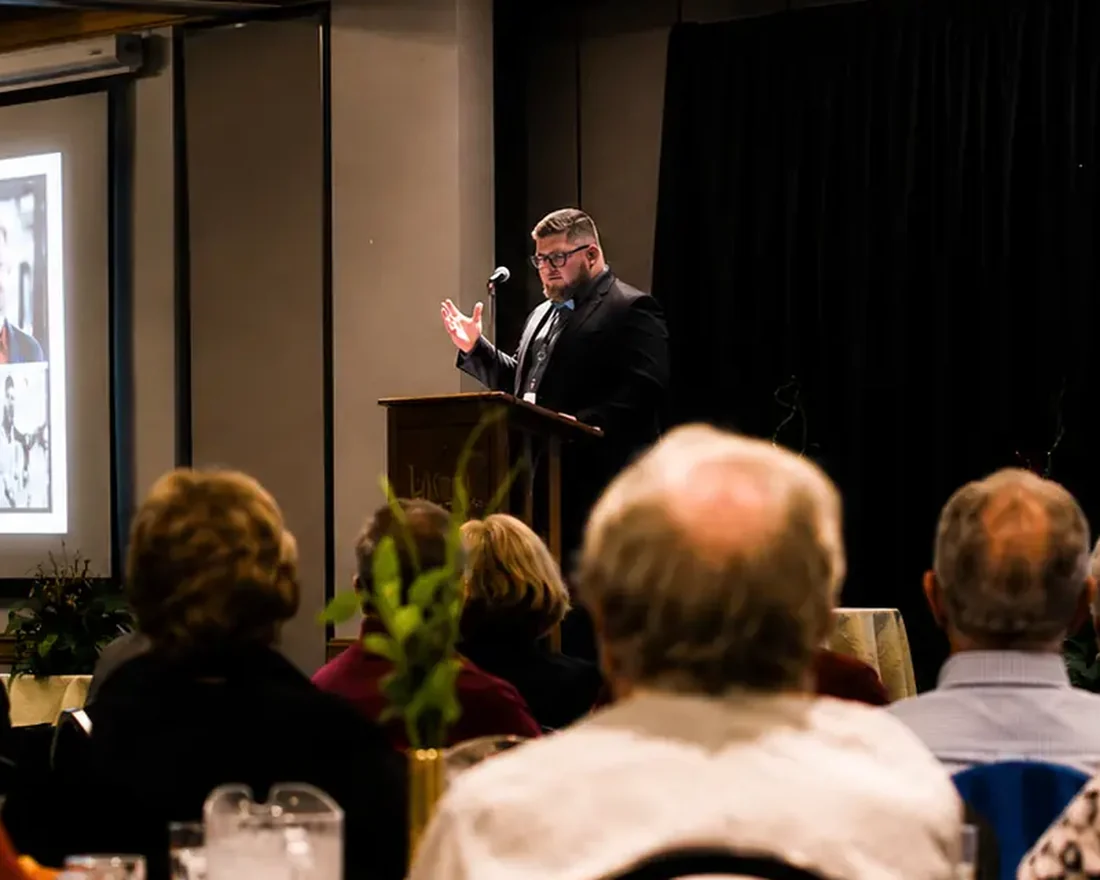
 Speaking
Keynote Audiences Remember
Changing your station, building through uncertainty, leading people, and what it actually costs to create something that works.
Book Luke to speakHow a young veteran who lost everything built his way back, and then built the company he wished he'd had. This is the long version, in Luke's own words.
I was born into poverty. I enlisted at seventeen, because the Army was the first door I found that led anywhere.
They spent sixteen weeks teaching me how to be a soldier and the next year and a half teaching me how to fight. Move on enemy terrain. Call in an airstrike. Call in a medevac. Lead people. Treat men with wounds you do not forget.
I was wounded in Afghanistan in 2012, at nineteen, with the 82nd Airborne.
I was out before I turned twenty-one.
They spent about seventy-two hours teaching me how to be a civilian. Hot classroom, lowest bidder, a man with a federal job who could not be fired if he was terrible at it. The resource was a packet, and the packet was not even for the state I lived in.
Then the door closes behind you and none of it transfers. Nobody in an office is hiring for terrain reconnaissance. Combat janitor was about the size of my qualification.
One day I had a mission, a team, and a structure built around me. The next day I was supposed to work out what came next on my own.
That is the wound they do not treat. No mission, no team, and no idea who you are without the uniform.
It is also why the rate is what it is. If you know a veteran, they know somebody who took their own life. I lost four friends in six months, and there was a stretch where I felt like I was waiting to find out when it was coming for me.
It took about seven years before small things stopped setting me off.
Call or text 988 and press 1 for the Veterans Crisis Line. Confidential, 24 hours a day.
By the winter of 2013 I had run out of money. Everything I owned fit in a Ford Mustang, and Cole rode shotgun.
Cole was a pitbull basset hound mix. Head of a pitbull, body of a basset, and no idea he was not a lap dog. There is a painting of him on my wall now.
I had benefits I had earned and no idea how to reach them. I would not have asked if I had known, because somewhere in the service you learn that needing help is something you keep quiet about.
I found out they existed at a food pantry. I did not know what a food pantry was until I needed one. The people working there took one look at me and started asking questions. How old are you. Did you serve. And then, you know you have benefits, right?
That sent me to the courthouse in a small Nebraska town, where a man named John Brim sat me down and started working out what I was owed. Somewhere in that conversation my grandfather’s name came up, and John stopped and told me that my grandfather had recruited him into the Army during Vietnam.
I had driven into a town I had never lived in, walked into a building I had never been in, and sat down across from a man my grandfather put in uniform forty years earlier.
John got me into a couple of programs and found me work monitoring work-release inmates at a sugar beet plant for seven dollars an hour. Flammable dust in every orifice, and men who had not breathed free air in years driving mini dump trucks around like a bad game of Mario Kart.
The job got me a double-wide trailer out in the middle of nowhere. It was so overrun with rats that Cole and I both got sick, and every piece of food I owned had to live in a plastic tote box on the floor, because the fridge was not safe and neither were the cabinets.
So that is what we ate out of. A tote box.
I had done everything they asked of me, and I still ended up in a car in the cold with a dog and no map for any of it.
There was a night in that trailer I did not think I would come back from. Not in the abstract. Planning it.
Then I looked at Cole.
What stopped me was not noble. It was: if I die, who feeds you?
What came after that I remember more clearly than almost anything in my life. Okay. If you are staying, make it count. You have got to live a life worth writing about, because the friends who are not here deserve something worth watching. And we are finished with the woe is me, the victimhood, the I have been through this so I am broken. Every fork from here, you take the one you cannot predict, and consequences be damned.
And look where you already are. Your clothes smell like mothballs. You eat out of a tote box on the floor of a trailer full of rats. You do not relate to anybody and you have got no friends besides this little four-legged idiot.
What exactly is left to be afraid of?
That night set my trajectory. Not figuratively. At every fork since, I have asked the same question, and taken the road I could not predict the end of.
Call or text 988 and press 1 for the Veterans Crisis Line. Confidential, 24 hours a day.
I have gone back over that night more than once, and this is what I think happened.
I did not stay because I found a reason to live. I stayed because something outside of me needed me, and that turns out to be a completely different mechanism and a much stronger one.
Cole was the first thing in my life that was bigger than me. After him it was my first company. After that it was getting veterans to a place where they could bet on themselves.
Everything I have built since has run in that order. Somebody in front of me needs something. I go and help. What I find underneath is a system that made their problem and is still running, and then I have got ten years of work.
It has never once started with a business idea. It started with a dog who needed feeding.
I decided to go to school because the trailer and the sugar beet plant were not taking me anywhere I wanted to end up.
I sat down with the veteran advisor and he asked what I wanted to study. I said nursing. I wanted to help people, and it was the only thing I had ever pictured myself doing.
He said that was great, and then he said the nursing program was competitive, and not everybody who applied got in.
That is all he said. He was not being cruel and he was not wrong. It was accurate information from a man doing his job.
And what I heard was: not you.
I said, oh. No, I do not think I could do that. I should probably do something easier. I walked out of that room enrolled in criminology and juvenile justice, and I signed up for the absolute minimum course load that still counted as full time, because I was frightened of taking on more than I could carry.
Halfway through that first semester I added another class. I finished on the president’s list.
The next semester, straight A’s again.
Only then did I let myself think it. I am actually good at this. I nearly failed out of high school and here I am with a brain that works and the discipline to use it.
So I switched to nursing.
Three semesters of proving it to myself before I would attempt the thing I walked in wanting on day one. That is how little I thought of myself.
And that is exactly where a lot of people are sitting right now, waiting for permission that is never going to arrive from anybody but them.
Years later I made it into nurse practitioner school in Michigan, and I knew almost immediately it was not it. It is a hell of a career and there was a ceiling on it I could see from the parking lot.
I was reading Think and Grow Rich, which is foundational to almost everything I have done. The tenet that stuck was simple. When you are stuck, go help someone else.
One morning I pulled into the school lot in my scrubs, sat there, and turned the truck around.
I drove to the Bay City Animal Shelter and told them I wanted to walk dogs. They asked how long a session I wanted to do. I asked how many dogs they had.
Thirty-eight.
Then that is probably a full day. What time do you open? Nine to six? How many days a week are you open? Six?
Then I will be here six days a week.
They looked at me like I was smoking crack. Some kid in scrubs, two days out of a graduate program, saying he is going to show up every day, all day, for free. I used my GI Bill money to buy myself the time. My financial planning was not fully developed at that point in my life.
I did not have a plan. A book gave me an instruction and I took it literally.
There was a pit bull on death row. Head the size of a football, body like a hot dog, mangy, and you could tell he had been beautiful when he was healthy. He had bitten a child, and in Michigan that is the end of it. I do not fault the state for the law.
Everybody there told me not to go in with him. Not as a suggestion. They had watched him long enough to have an opinion worth listening to, and they told me he would take my face off.
It took a long while in that cage before he would let me get a collar on him. When I took him out to the pen and let him off the lead, he did try. I got a few nicks and I kept going back.
One afternoon I sat outside with him for three or four hours, and somewhere in it I looked at him and thought: you let the traumas of your past drive you to the one action that became your demise.
Then I asked myself what I was doing that was the same.
Rudy did not make it. What he taught me in an afternoon has since reached thousands of veterans and their families.
About thirty days into the shelter I was on a Facebook group looking for a roommate in Austin, and a woman posted about a dog who was about to be put down. He had been in a shelter since he was twelve weeks old and he was a year old by then. Horrible anxiety, seemed friendly. Genesee County.
Genesee. That is forty-five minutes from me.
They needed a catch pole to get him out of the crate, because he had spent twelve months sitting in his own mess. In the visitation room he went straight to a corner and would not let a human near him.
I said I would take him.
I could not save Rudy. I did bring Whiskey to Texas. His name is Whiskey now because he makes me want to drink, he steals food off every counter in my house, and everybody who comes over loves him.
I moved to Austin and took a job as a mortgage loan originator. They sold me a Wolf of Wall Street pitch. Sharp kid, you will make a million dollars.
What the business actually did was sell predatory refinances to people who could not read them, and then foreclose on the homes.
I never closed a single deal there. I lasted about three months, and on my way out I sent a company-wide email telling every one of them exactly what they were. That did not go over well.
Austin was booming, and if you could write a line of code you could make eighty grand, so I spent a year teaching myself. Then a coding camp. Out of fifty people in that class, two of us got jobs immediately. Me and one other veteran.
At that first engineering job the company got hit with an accessibility lawsuit. Thirteen thousand employees, and I was nobody in it, four months off the street with a certificate.
It was a predatory suit and nobody had actually been harmed, but I sat up that night asking how I keep this company that gave me a shot from getting screwed.
My mother had married a man who happened to be blind. His name was Ken.
I was on a treadmill when it landed. I stopped the machine and called him. If I got you paid to sit next to me and tell me where this is broken, and then tell me whether my fixes actually work on a screen reader, would you do it?
He said yes.
The next morning I messaged the CEO and the CTO. Two hours later I was pitching them, and I have rarely been that frightened. They flew me to Nebraska the next day. In seven working days Ken and I mitigated the suit and saved the company millions. He got paid, I got paid, I got promoted.
Then came the part that changed my life.
I was elated. We had done a thing. Ken was flat.
I asked him what was wrong. He said: Luke, for the first time in my life I felt intellectually valued. And it sucks, because it is never going to happen again.
I said, what do you mean? You are blind, not dumb.
So he explained it to me. Every job in this country runs on two or three pieces of software. A point of sale, a CRM, a support system, email. If you cannot use the software, there is no job. And almost none of it is built to work without eyes, because so much of software is visual cueing that nobody notices doing. The size of the button. The color of the button. A screen reader on its own does not get you there.
Then he told me where he had worked before.
There is a carve-out in federal law that lets certain nonprofits pay disabled workers less than minimum wage. The reasoning offered is that a full wage would cost them their benefits, so the low pay gets framed as protection.
Those nonprofits run warehouses. Ken spent twenty years in one of them making toilet paper for the United States military and the federal prison system. He was good at it. He worked his way up to line manager.
The promotion did not come with more money, because it could not. He was still under the carve-out. He got the responsibility and they got the output, and his pay stayed where it started.
That is the design. It does not matter how high you climb inside it. You do not get paid more. They just get more out of you.
I have always been the one who goes after the bully. I was a big kid, and in whatever room I have been in I have stood up to it even when standing up meant getting hit.
This was a bully, and nobody had designed it that way on purpose, which somehow made it worse.
So I said no.
The company laid everybody off a few months later, and I took that as my answer.
I spent the next year building Clusiv, the first e-learning platform made for people who are blind or visually impaired, with a team that was seventy percent visually impaired. This was before you could build a company with low code and AI. Every piece of it was a real engineering job and I was nowhere near good enough to do all of them.
Which meant I needed money. To get the first check I pitched a hundred and eighty-five investors.
People think a rejection is your idea is not for us. Sometimes. Other times it is your idea is dumb and you are dumb and why did you waste our time. Or they are too scared to give you real feedback, so they say you are too early, and you walk out having learned nothing and do it again the next day.
I lived on ramen and worked side jobs to stay afloat while going full time on something that did not exist yet.
How do you build the nerve to keep pitching when it is not your world? Reps. You have to be willing to look like an idiot in public. Anybody who says they walked in knowing how is lying.
Then one said yes.
A week later the managing director of Techstars called me and said, you are my first call, you are in. Twelve thousand companies apply for ten places.
The entire physics of the thing changed overnight. I remember raising thirty-five thousand dollars from seven people by text message while sitting on a toilet. I had set out to raise five hundred thousand. We closed the round near a million.
Nothing about the company changed that week. The sentiment changed.
I had built it to sell into government agencies, because blind users do not have a lot of discretionary income for software but vocational rehabilitation agencies do.
Then the funding line those agencies depended on was cut. Every contract we had was cancelled.
I laid off my entire company two weeks before Christmas, in December of 2023.
Which leaves you with a question you cannot put down. Am I a one-hit wonder, and was even that a hit?
I took a job with the government after that, assessing AI companies and the people running them for whether they fit federal needs. Flying in and out of Washington. It was genuinely interesting work and there was a little power to it when you walked into a room.
It did not scratch anything.
In February of 2024 I sat down and wrote one line on a note card. Within seven months I will be earning thirty thousand dollars a month.
I still have the card. Within seven months I was.
What made it VetClaims was a lunch. One of the men I worked alongside has three Purple Hearts and has been shot five times, and somewhere in that conversation it came out that the VA had him rated at thirty percent disabled.
Thirty percent. My toenails should be rated thirty percent.
So I went looking for somebody who could help him fix it, the way you would look for a good mechanic. What I found was that in the ten years since my own discharge, nothing had changed. The same maze I could not navigate at twenty was still sitting there with a friend of mine stuck in it.
Here is what a veteran is actually up against. You have to prove not only that you are injured but that the injury connects to your service, and the proof the VA accepts is specific in ways nobody explains. Over seventy percent of first claims come back denied or rated too low. Most men take that as the answer.
Getting it right is worth twenty to fifty thousand dollars a year to that man, tax free, for the rest of his life. That is not a nice outcome. That is a different life.
Nobody had built a real fix, and there is a reason. Federal rule stops accredited agents and attorneys from charging a fee to prepare a first claim. The intent was to keep predators away from people who had just come home. The effect is that the people best equipped to help have no way to be paid for it, so they do not, and the veteran is alone with the paperwork.
We built it anyway, inside the rules, at a flat fee, taking nothing from anybody’s backpay.
Zero to four hundred and thirty-eight people in twenty-two months. Most of them veterans. Eight thousand more come through every month.
I built the company I wished I had found when I was getting out. If you ask me what I am proudest of, it is that.
Somewhere in there my own employees started calling me CEO Daddy. I did not pick it and I cannot shake it.
I do not have to work sixteen and eighteen hour days anymore. I have the people and I could hire more. I do it anyway.
Part of that is that I love it. The other part is closer to martyrdom. It is not my life that matters, it is the thing I am fighting for, and I will take that as far as it goes.
That comes with a bill. It makes you a hard person to love. It takes something out of you that does not come back on a weekend. It probably costs me years on the other end.
It also builds a level of resilience that is frightening to anybody planning to be an obstacle, because they have never come up against somebody willing to take it all the way.
On survivor’s guilt, plainly: there are things you do not get to unsee, and no amount of therapy or medication takes them back out of you. What you can do is attach them to a mission and turn something unfixable into a disgusting amount of work. It does not cure anything. It gives it somewhere to go, and it means what you carried out of there was not carried for nothing.
Most people coming out of any transition, not just service, are trying to fill a hole. They chase the camaraderie they lost or they find something to drink so they stop noticing it is gone. What they are short of is a mission.
A man with a solid enough reason can survive almost any set of circumstances. Nobody ever tells you how to find the reason.
When my grandfather died, the church could not hold the people who came. They ran three separate services to get everybody through, and the National Guard had to send a second honor guard team because the first could not keep up.
By every account I have heard, he was a difficult man when he was young.
That is the measure I use now. Not revenue, not headcount, not what is parked outside. How many people would come.
These days I keep a ranch outside San Antonio.
Five longhorns I pulled from auction, one of them twenty-one years old and on her last pasture. I told the owner to cut me a deal and I would guarantee they lived out their lives here and he could visit whenever he wanted. There is a mini highland cow named Ruby who is a seven hundred pound puppy. A donkey. And Whiskey, still stealing food off the counters.
I know nothing about cows. Not one thing. But I have grass and water and we will figure out the rest, which is more or less how I have approached everything since that trailer.
When I have run myself into the ground, which is often, the thing that brings me back is out there. I go and sit with the animals.
The point was never to grind forever. The point was to build something that outlasts the reason I started.
Whether it’s a stage, a conversation, or a problem you’re trying to solve, Luke is interested in the places where experience matters more than another playbook.
SpeakingChanging your station, building through uncertainty, leading people, and what it actually costs to create something that works.
Book Luke to speak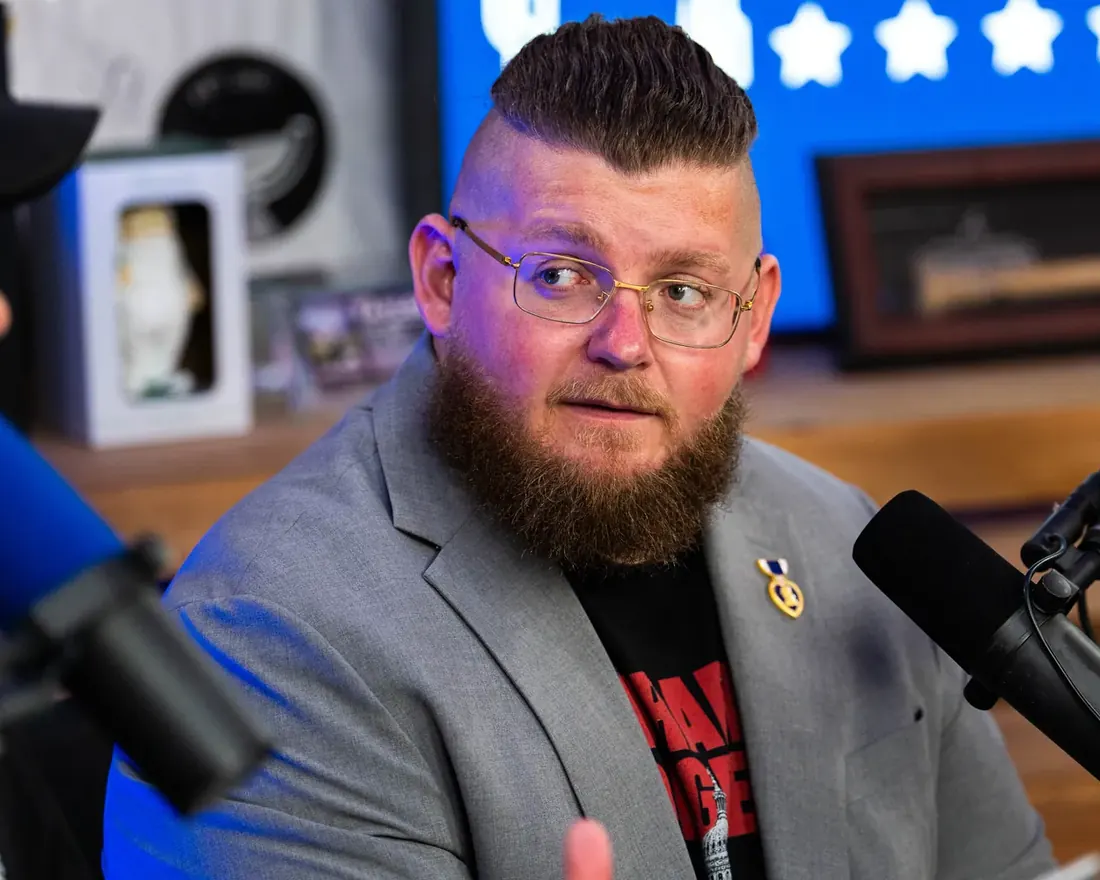 Media
MediaPodcasts, interviews and real conversations. Give Luke the questions your audience actually cares about, not a script.
Have Luke on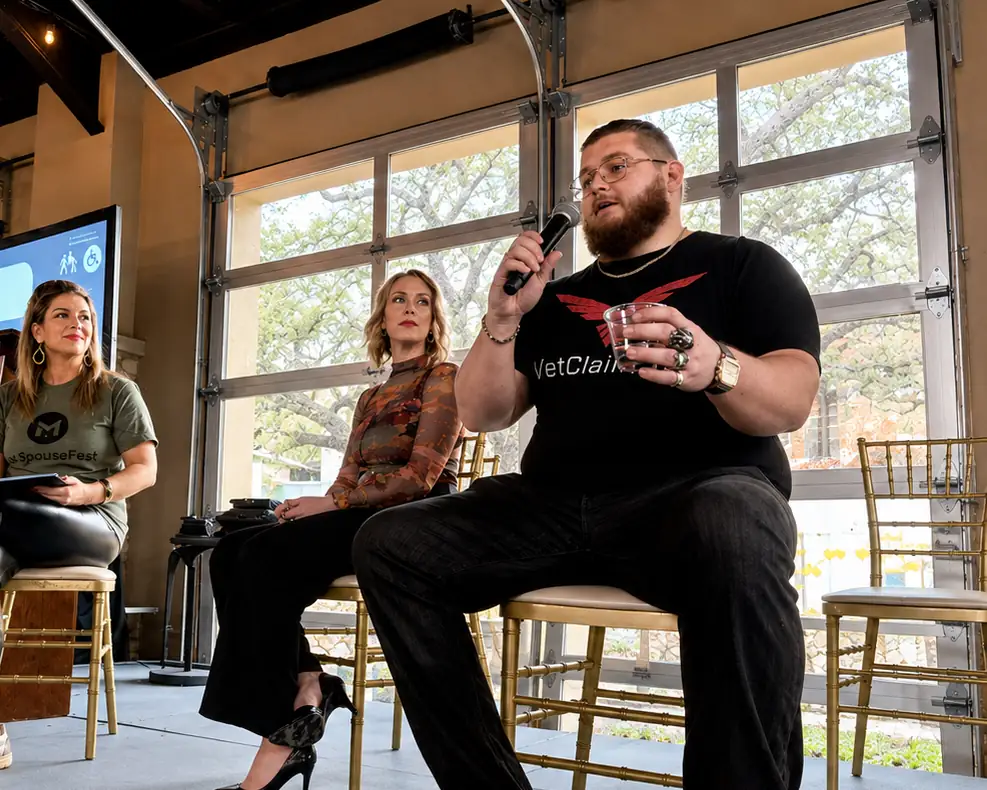 Consulting
For founders, leaders and companies working through growth, change, or a problem that doesn’t have an obvious playbook.
Bring Luke in Collaborations
Building something you think Luke should know about? Tell him what it is and why you think he belongs in it.
Start a conversation